FlexAFM and nanomotion sensing unveil cellular responses, offering new insights into bacterial behavior and potential ...


27.04.2026
Discover the instrument behind this story: DriveAFM
Characterizing samples in nanotechnology and microfabrication requires a broad range of tools. The requirements of researchers can be many, from careful examination of the morphology to a high resolution imaging of the magnetic properties or an accurate map of the elasticity. To satisfy all the different needs, at the Institute of Electronics, Microelectronics and Nanotechnology (IEMN) in Lille, a city in northern France near the Belgian border, researchers have access to the Scanning Probe Microscopy facility. This facility provides instruments for atomic-scale surface analysis, including Atomic Force Microscopes (AFM), Scanning Tunneling Microscopes (STM).
At IEMN, researchers have extensive experience with AFM and work with a wide range of instruments from various manufacturers. The lab is particularly active in molecular electronics, focusing on determining the electronic properties of molecules and testing their responses to external stimuli such as photo-switching or chemical interactions. AFM is operated in conductive atomic force mode to probe variations in molecular conductivity. The lab is also specialized in studying the thermal properties of organic semiconductors, and a new research activity is dedicated to investigating battery materials.
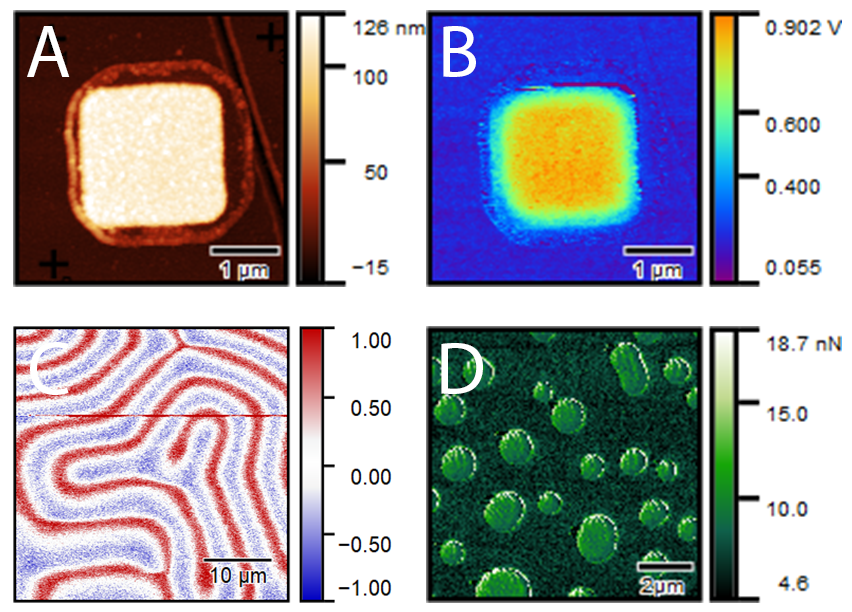
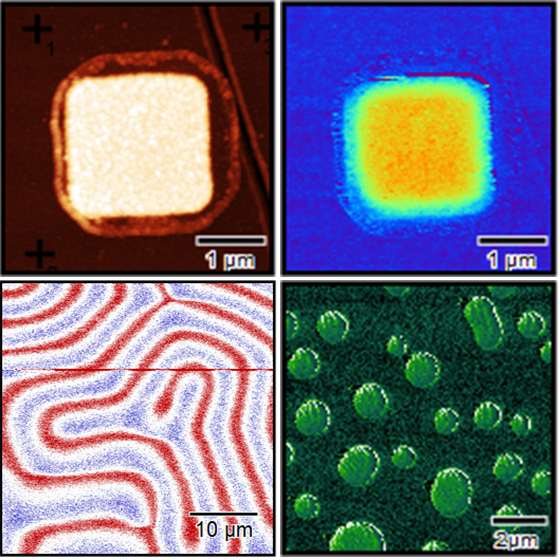
Sample of data of reference samples acquired at Scanning Probe Microscopy facility with different modes. A topography and B surface potential in Kelvin Probe Force Microscopy,
C Magnetic Force Microscopy, D adhesion mapping. Credits: IEMN-ECM.
Among other instruments, the Scanning Probe Microscopy facility now includes two high-end DriveAFM systems by Nanosurf, acquired in fall 2025 thanks to the funding of the French Renatech network, project IMITECH, CPER Hauts de France. To ensure maximum precision and minimize contamination, one of them is installed inside an Argon glovebox, which allows samples to be analyzed in an oxygen- and water-free environment. While it is still early to obtain complete results from the capabilities of DriveAFM, some features are already highly appreciated. “I like that the controller is very open, so we can easily play with signals. It's easy to communicate with other instruments,” says Louis Thomas, research engineer at the facility. “The spectroscopy functions in Nanosurf Studio software are very nice because we can precisely configure every step and write exactly what we want to do. That helps researchers a lot.” Versatility and customization are key features of Nanosurf Studio software, control of the DriveAFM. The head of the unit, Maxime Berthe, adds that “the high integration and triggering of both inputs and outputs is very important and very useful on DriveAFM.”
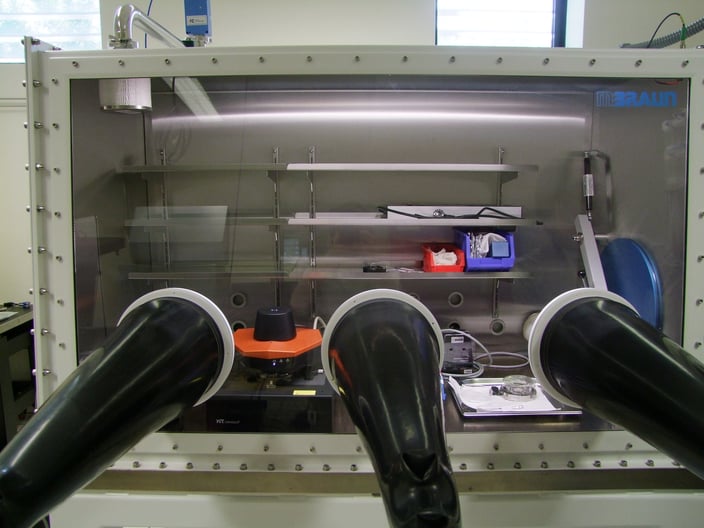
DriveAFM inside the glovebox at Scanning Probe Microscopy facility. Credits: IEMN-ECM.
Talking about the hardware, Louis Thomas tells that “something that we really like of the DriveAFM is CleanDrive. We've been doing measurements in liquid recently and it is much easier to have a clean frequency sweep of the cantilever oscillation. It really helped us achieve good results”. CleanDrive is a technology developed by Nanosurf and available only on DriveAFM, where an additional laser photothermally excites the cantilever. CleanDrive can be operated at the resonance frequency to enhance measurements in Dynamic Mode. In traditional dynamic mode, the cantilever is excited by a piezo, but the indirect excitation may lead to a poor signal-to-noise ratio. Conditions such as measurements in liquid typically cause the so-called forest of peaks, an amplitude response spectrum with many local maxima. Changes in environmental conditions or tip-sample separation can cause shift in frequency of those local maxima, making it even more complicated to find the correct resonant oscillation frequency. Through photothermal excitation, CleanDrive significantly enhances the performance of the DriveAFM in dynamic mode, improving signal stability in air and liquid and making it easier to stably excite at resonance.
The Scanning Probe Microscopy facility is part of the Multi-Physics Characterization platform. This includes four different branches and provides the opportunity to study nanometer-scale and electronic systems at various levels. While materials can be analyzed at the Scanning Probe Microscopy unit, components are typically examined at the Microwave, Optical and Photonic Characterization unit. Devices are prototyped at SigmaCom, which focuses on the characterization of communicating systems and prototyping, and they can be further developed and studied in their electromagnetic environment at the pole for Characterization and Compatibility Electromagnetic and Prototyping (C2EM). Thanks to the presence of all these facilities, researchers at IEMN are well equipped to make outstanding discoveries and develop cutting-edge technologies.
23.06.2026
FlexAFM and nanomotion sensing unveil cellular responses, offering new insights into bacterial behavior and potential ...

27.05.2026
Explore Alejandro Silhanek’s innovative spintronics research, showcasing how spin waves can be investigated leveraging ...
.jpg?width=330&height=330&length=330&upsize=true&upscale=true&name=Mayfield%20Girls-202581%20(1).jpg)
19.05.2026
A group of young girls from Mayfield school wanted to start a F24 electric car racing team, and Nanosurf decided to ...
11.07.2024
FridayAFM: learn how to perform datamining on large sets of AFM data.
02.07.2024
FridayAFM: learn how to automatize data analysis in MountainsSPIP
26.06.2024
FridayAFM: learn how AFM makes possible modern ball point pens.
Interested in learning more? If you have any questions, please reach out to us, and speak to an AFM expert.