FlexAFM and nanomotion sensing unveil cellular responses, offering new insights into bacterial behavior and potential ...


01.12.2025
Polymers are essential components in many devices and materials used in everyday life, often without us noticing. Materials such as polyethylene (PE), polypropylene (PP), and polyethylene terephthalate
(PET) are commonly found in food containers, wrapping films, and bottles. Polymers also play a key role in the organic LED screens of smartphones, while synthetic fibers like polyester and nylon are widely used in clothing. In industrial applications, polymers are valued for their surface properties, including permeability control, mechanical durability, and light reflectivity.
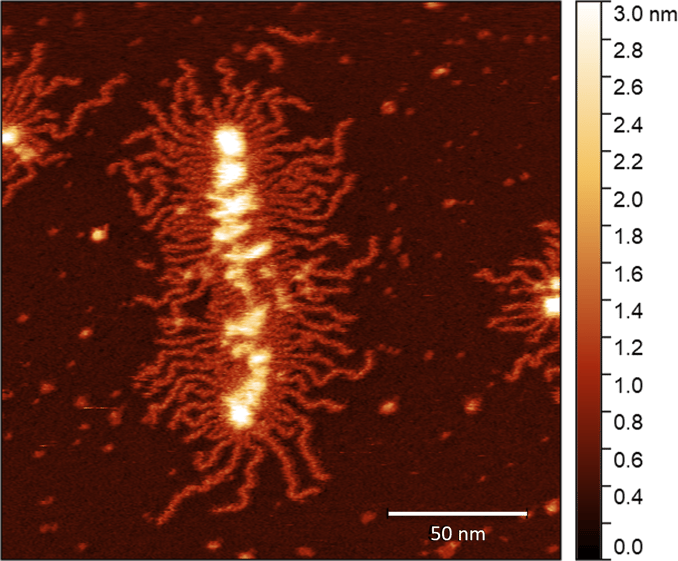
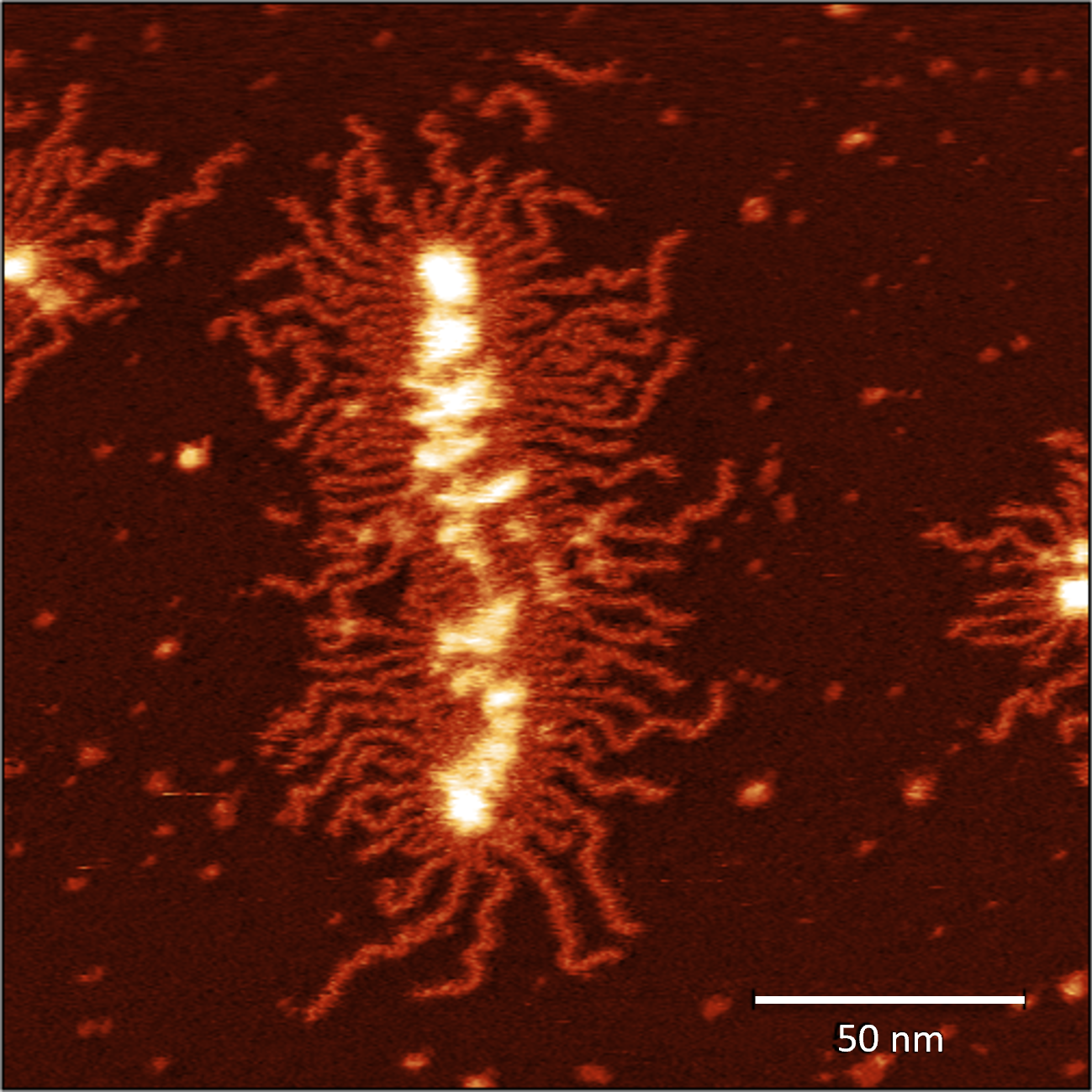
A bottlebrush polymer deposited on mica in liquid environment imaged with DriveAFM in WaveMode.
It is possible to resolve the backbone and the individual side chains.
The properties of bottlebrush polymers are closely linked to their molecular conformation. To fully understand these materials, researchers need a technique capable of imaging individual polymer molecules directly on the surface of interest, with the highest resolution in all three spatial dimensions. Atomic Force Microscopy (AFM) is well-suited for this purpose. However, not every instrument on the market can capture high-resolution images of bottlebrush polymers. With side chains spaced only few nm apart, every detail matters, including speed. The sample must reach equilibrium with the AFM tip and the rest of the system, but these conditions are disturbed by the instrument itself. Slow scanning speeds can lead to significant drift, distorting the image and making it difficult to resolve molecular features. Even under ideal conditions, perfect equilibration is nearly impossible, and drift remains a persistent challenge at the nanometer scale.
To address this limitation, Nanosurf has developed WaveMode off-resonance imaging for its high-end DriveAFM system. Being up to 15 times faster than similar modes in ambient conditions, WaveMode overcomes the effects of drift through shorter imaging times.
WaveMode is the fastest off-resonance AFM mode available, enabled by the photothermal effect. This effect transfers energy from an infrared laser beam to the cantilever, allowing off-resonance oscillation without the limitations imposed by the f/Q ratio in dynamic mode.
For example, when bottlebrush polymers are deposited onto mica, it becomes possible to count the number of side chains per molecule, a task that is notoriously difficult with conventional AFM techniques. Using WaveMode, our Application team achieved image quality high enough to resolve the entire molecule and accurately count the side chains. This level of detail opens new possibilities for characterizing polymer architecture at the single-molecule level.
Another example involves studying the mechanical properties of polymer particles, which requires AFM-based spectroscopy. The main challenge here is the weak adhesion of polymers to the substrate. Traditional AFM modes often push particles around during measurement, but WaveMode solves this by enabling precise control over the tip-sample interaction. This makes it possible to probe mechanical properties without detaching the particles. Fast, gentle, and easy to use, WaveMode is shaping the future of polymer characterization.
23.06.2026
FlexAFM and nanomotion sensing unveil cellular responses, offering new insights into bacterial behavior and potential ...

27.05.2026
Explore Alejandro Silhanek’s innovative spintronics research, showcasing how spin waves can be investigated leveraging ...
.jpg?width=330&height=330&length=330&upsize=true&upscale=true&name=Mayfield%20Girls-202581%20(1).jpg)
19.05.2026
A group of young girls from Mayfield school wanted to start a F24 electric car racing team, and Nanosurf decided to ...

08.12.2024
Learn how to make a Python code to interface your AFM with a gamepad.

01.10.2024
Discover how different types of glass age and degrade over time, and learn how to use AFM technology to investigate ...
02.07.2024
FridayAFM: learn how to automatize data analysis in MountainsSPIP
Interested in learning more? If you have any questions, please reach out to us, and speak to an AFM expert.