FlexAFM and nanomotion sensing unveil cellular responses, offering new insights into bacterial behavior and potential ...


02.02.2026
AFM for manufacturers: industrial solutions
Over the last two decades, Nanosurf has increasingly faced industrial challenges. The size and complexity of atomic force microscopy (AFM) machines have continued to grow, and as the company’s expertise expanded, so did the knowledge of its team. Dr. Andreas Lieb has gradually specialized in AFM stage design, working closely with the rest of the Nanosurf team. “Many people have misconceptions about AFM. They think that if they buy the best AFM and build their own sample holder and stage, they can measure anything they want. This is not true because an AFM system is everything between the tip and the sample, including the stage,” Andreas explains.
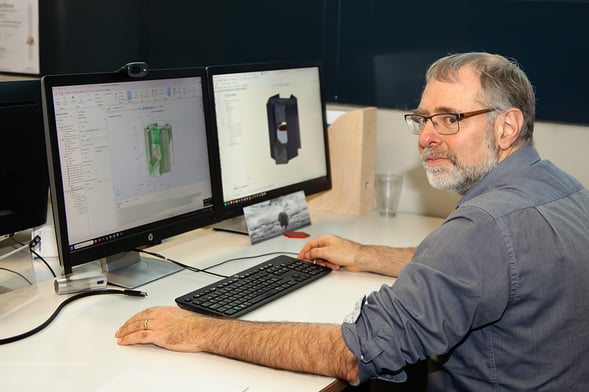 Dr. Andreas Lieb at work engineering a stage for a high-quality industrial AFM system.
The wrong stage can undermine the effort of building an effective AFM solution. Every mechanical object oscillates at specific frequencies, which, in the case of an AFM stage, can degrade measurement quality. Andreas clarifies: “If you have vibrations between the sample and the AFM tip, in the data they appear identical to topography. So, we must ensure that our stage does not vibrate at frequencies visible in our measurements.”
Technically, this means the stage’s resonance frequencies must be above the AFM measurement bandwidth. Typically, for large machines, the stage resonances cannot be pushed very high, therefore the scanning frequency must be low. Smaller machines designed for smaller samples can reach higher stage resonance frequencies, allowing the AFM to scan at higher frequencies. The challenges are not limited to vibrations along the azimuthal axis but also involve planar precision. Depending on the application, high repositioning accuracy may be required to measure specific features repeatedly. In other cases, such as surface roughness measurements of silicon wafers or precision optics components, this may not be critical. Stages designed at Nanosurf can have repositioning precisions down to 0.5 µm depending on the number of axis of the system and the needs of the customer.
Andreas was part of the Nanosurf team that built an AFM weighing more than 25 tons for a precision optics manufacturer. “When I was at university building my first scanning probe microscope, if someone had told me we would build such a large instrument, I would not have believed that it was possible!” Andreas comments with a smile.
When designing a stage, engineers must always consider the “mechanical loop,” which refers to the shortest path through the AFM hardware that mechanically connects the cantilever tip to the measurement site on the sample surface. A small mechanical loop is typically more stable and less sensitive to thermal variations, but length is not the only parameter, also the material matters. For its damping capacity and thermal properties, granite is one of the most commonly used materials. Granite is a coarse-grained rock composed mainly of quartz, feldspar, and mica. It forms from the slow cooling of magma deep within the Earth’s crust and is known for its strength, durability, and stability.
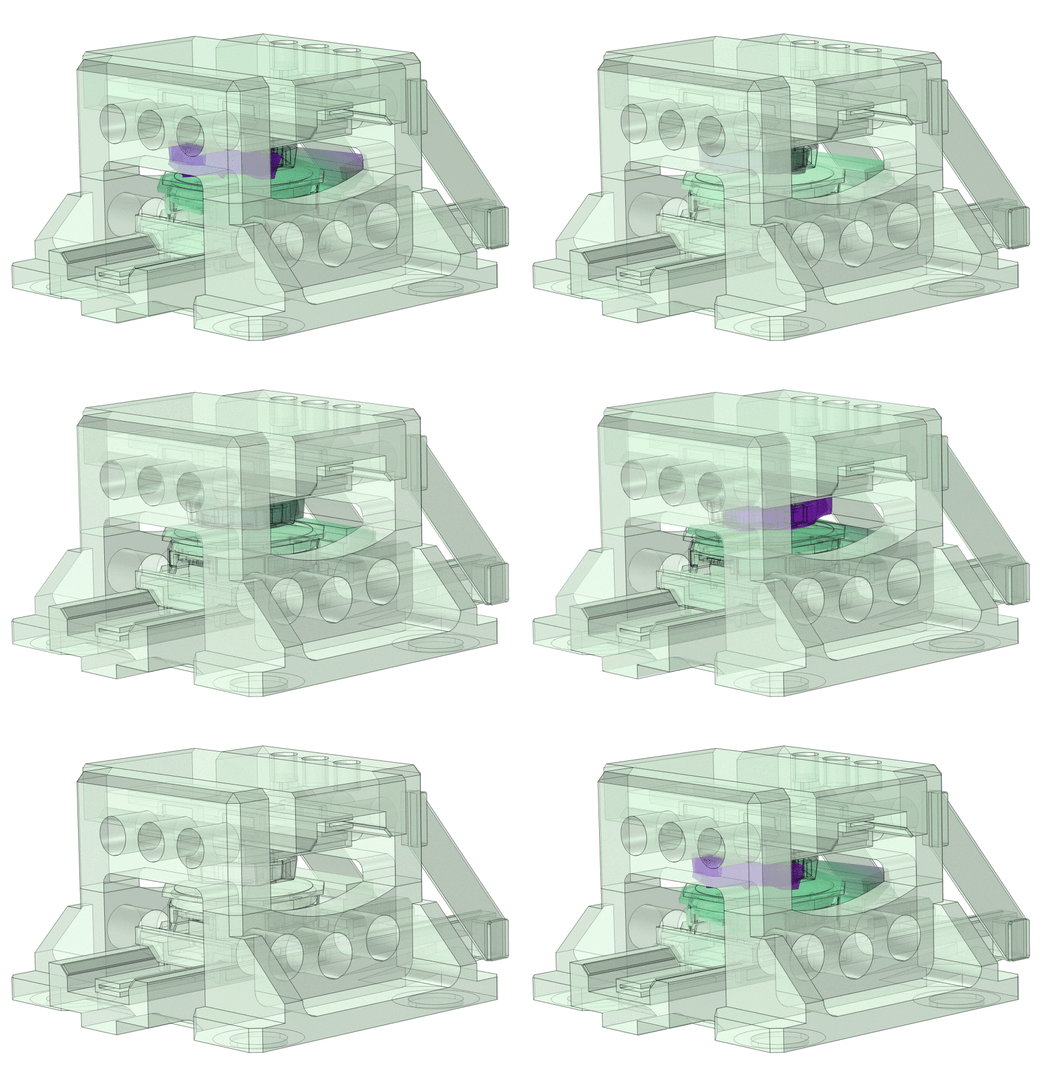 Computer simulation of a system oscillation mode. In the center, a representation of the DriveAFM head above the sample stage can be seen.
Andreas and his team use finite element method (FEM) simulations to calculate system performance. These simulations explore the physical limits of the design, accounting for all possible mechanical disturbances. This process requires not only computational resources but also close collaboration with suppliers, who provide precise details for accurate component modeling.
If the best solution for the customer is a system from the Alphacen series—Nanosurf’s products dedicated to 200 mm and 300 mm silicon wafers—the stage design takes only a few weeks. For non-standard systems, especially very large ones that accommodate non-planar samples, the process can take months. “It’s often a back-and-forth process. We develop the specifications with our customer and ensure their requirements are appropriate for their needs, while also considering what is realistically achievable.”
Designing the stage of an AFM system is a complex task with no predetermined solution. There are numerous potential configurations that must be quantitatively tested before selecting the one that meets customer requirements. Andreas, with the experience he has gained step by step, is able to generate concrete ideas and evaluate different options before selecting the one that best fulfills the technical specifications, ensures mechanical stability, and supports the required measurement precision.
To read more:
DriveAFM Performance without compromise
WaveMode: Simple and Fast Imaging With Accurate Force Control
23.06.2026
FlexAFM and nanomotion sensing unveil cellular responses, offering new insights into bacterial behavior and potential ...

27.05.2026
Explore Alejandro Silhanek’s innovative spintronics research, showcasing how spin waves can be investigated leveraging ...
.jpg?width=330&height=330&length=330&upsize=true&upscale=true&name=Mayfield%20Girls-202581%20(1).jpg)
19.05.2026
A group of young girls from Mayfield school wanted to start a F24 electric car racing team, and Nanosurf decided to ...
11.07.2024
FridayAFM: learn how to perform datamining on large sets of AFM data.
02.07.2024
FridayAFM: learn how to automatize data analysis in MountainsSPIP
26.06.2024
FridayAFM: learn how AFM makes possible modern ball point pens.
Interested in learning more? If you have any questions, please reach out to us, and speak to an AFM expert.