FlexAFM and nanomotion sensing unveil cellular responses, offering new insights into bacterial behavior and potential ...


11.11.2026
Discover the instrument behind this story: DriveAFM
Producing high-fidelity audio equipment requires constant innovation. Waves Audio, a leading company in the field based in Tel Aviv, Israel, pursues multiple research lines. While the mainstream efforts focus on signal processing-based techniques for sound applications at the professional and consumer level, the projects led by Dr. Gabriel Zeltzer are developing cutting-edge hardware and novel materials technology, in particular that of using 2D materials such as graphene at the heart of highly fidelity and efficiency electro-acoustic audio devices.
In physical terms sound is a mechanical wave transmitted through air. Microphones sense these waves and convert them into electrical signals, while speakers and headphones perform the reverse. All these devices rely on an oscillating membrane to either capture or emit acoustic waves. Among other factors, audio quality depends heavily on the mechano-elastic, thermal and electric properties of this membrane. After a decade of research, Zeltzer and his team at Waves Audio have developed devices for acoustic sensing and emission whose membranes consist of a single layer of graphene, leveraging the unique properties of this extraordinary two-dimensional material.
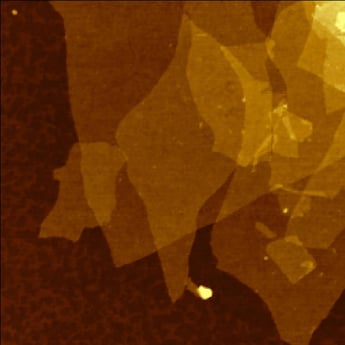
Topography image of multilayer graphene recorded with the FlexAFM. The different height levels of the various graphene layers can be clearly distinguised. Image size 5.11 µm x 5.11 µm, color scale 12 nm. Sample courtesy: Nanotech Energy, USA. (Nanosurf)
Graphene is exceptional for audio membranes because it combines ultra-low mass with extreme stiffness and electrical conductivity, properties that rarely coexist. Traditional materials either add weight, which slows response, or sacrifice rigidity, which causes unwanted resonances. Graphene, just one atom thick, has an incredibly low areal density, minimizing inertia, while its Young’s modulus of about terapascal gives it steel-like rigidity. This means a graphene membrane can vibrate across a vast frequency range from deep bass to ultrasonic without flexing or breaking up. Its low damping and high mechanical strength also enable near-lossless conversion of electrical energy into mechanical vibration, making it both efficient and precise.
The concept originated from a research group led by Qin Zhou and Alex Zettl at the University of California, Berkeley, who published a paper in the Proceedings of the National Academy of Sciences (PNAS) in 2015 demonstrating graphene’s ability to record extremely high frequencies. Their prototype could capture audio in diverse environments, even detecting bat ultrasounds in a public park in Berkeley.
“Together with the Virginia Tech chemistry department, we developed a new material that did not exist before, using single-layer graphene combined with a very strong polymer capable of meeting mechanical requirements over large areas, providing freestandingt capability for an electrically active membrane,” Zeltzer explains. His group created a composite of graphene and polymer that could cover much larger areas than the Berkeley team achieved. They reached the highest ratio between membrane diameter and thickness, exceeding 10^5, suspending 40 millimeters of graphene with a total thickness of 300 nanometers. The graphene itself was a single layer, about one-third of a nanometer thick, while the remaining thickness consisted of nearly 300 nanometers of polymer. “This effectively created a system that could serve as both a microphone platform and a speaker in an electrostatic configuration,” Zeltzer adds.
Fabrication begins with graphene synthesized via Chemical Vapor Deposition (CVD) on a copper substrate. “That is the foundation of the material construction process. Then you need to engineer and understand the material, employing all available nanotechnology tools for characterization and quality control. Understanding the relationship between graphene and the polymer requires much more than optical characterization, that’s where AFM came into play.”
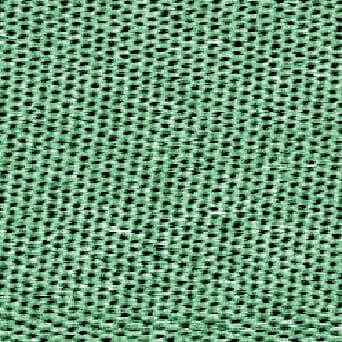
Conductivity map of highly ordered pyrolytic graphite (HOPG) measured with DriveAFM. The image shows atomic resolution at 30Hz line rate. Image size 6 nm x 6 nm, color scale 150 pA. (Nanosurf)
When studying the surface structure and shape of the films, the team discovered strong interactions between the polymer and the graphene layer. Since the graphene remains on the copper substrate used for CVD growth, the way the polymer conforms to the graphene surface strongly influences the overall structure. This interaction is not only mechanical but also chemical, leading to strong bonding at the interface. As a result, the combined polymer–graphene system becomes electrically active, with its electrical properties closely tied to how the two materials connect while maintaining the superb graphene surface conductivity.
“So, the AFM gives us more than just topography. It provides conductive visualization over relatively small but relevant areas. I could see atoms on Highly Oriented Pyrolytic Graphite (HOPG)—a very pure and well-ordered form of graphite often used in research and nanotechnology—so it offers very high resolution. For us, that’s crucial because we’re examining features at the level of planes of different heights and that of specific samples of graphene on copper and their surface topography.” While characterizing the material, the researchers aim to understand topography, morphology and electrical properties over surface areas on order of tens of microns, with Z-axis resolution down to the atomic or even subatomic level.
“The Nanosurf DriveAFM has that capability. It’s a very robust system and easy to operate at that level. It’s like the Swiss Army knife of atomic force systems. I was impressed with its design, the cleanliness of the optics, and the high resolution of the sensing,” Zeltzer says.
“I believe exposing these tools to engineers and scientists working in acoustics and designing new components could benefit both fields, nanotechn ology and audio. I was fortunate to bridge that gap within Waves Audio,” he concludes.
To read more:
DriveAFM Performance without compromise
Related publication:
Mutually Reinforced Polymer–Graphene Bilayer Membranes for Energy-Efficient Acoustic Transduction
28.10.2026
FlexAFM and nanomotion sensing unveil cellular responses, offering new insights into bacterial behavior and potential ...

23.06.2026
FlexAFM and nanomotion sensing unveil cellular responses, offering new insights into bacterial behavior and potential ...

27.05.2026
Explore Alejandro Silhanek’s innovative spintronics research, showcasing how spin waves can be investigated leveraging ...
11.07.2024
FridayAFM: learn how to perform datamining on large sets of AFM data.
02.07.2024
FridayAFM: learn how to automatize data analysis in MountainsSPIP
26.06.2024
FridayAFM: learn how AFM makes possible modern ball point pens.
Interested in learning more? If you have any questions, please reach out to us, and speak to an AFM expert.