FlexAFM and nanomotion sensing unveil cellular responses, offering new insights into bacterial behavior and potential ...


23.06.2026
Discover the instrument behind this story: FlexAFM
Sensing cells with atomic force microscopy can reveal a wealth of information. For example, applying pressure with a large, rounded tip allows researchers to study cellular responses to mechanical stimuli, while probing local stiffness with a sharp tip provides insights into cytoskeletal dynamics. Mechanical measurements are often combined with optical microscopy to examine cell dimensions or track their spatial movements.
Beyond migration and conformational changes, cells exhibit additional mechanical behaviors. For instance, they vibrate, and atomic force microscopy is an effective technique for detecting these vibrations. This approach, known as the nanomotion sensor, was developed by Giovanni Longo. At the time, he was a postdoctoral researcher at the École Polytechnique Fédérale de Lausanne in Switzerland. Today, he applies this technique to investigate human cells and bacteria at a fundamental level in his laboratory at the Consiglio Nazionale delle Ricerche in Rome, Italy, with his colleagues Simone Dinarelli and Marco Girasole.
The nanomotion sensor exploits the sensitivity of the AFM cantilever to measure the vibrations produced by a group of cells placed on it. “We study living biological systems. This means we take biological systems, such as bacteria or cells, and observe how they change. We focus on how their properties vary in relation to external stimuli, in other words, how they respond to external factors.” This represents a biophysical, multidisciplinary approach that investigates cellular oscillations, a pathway that remains relatively niche.
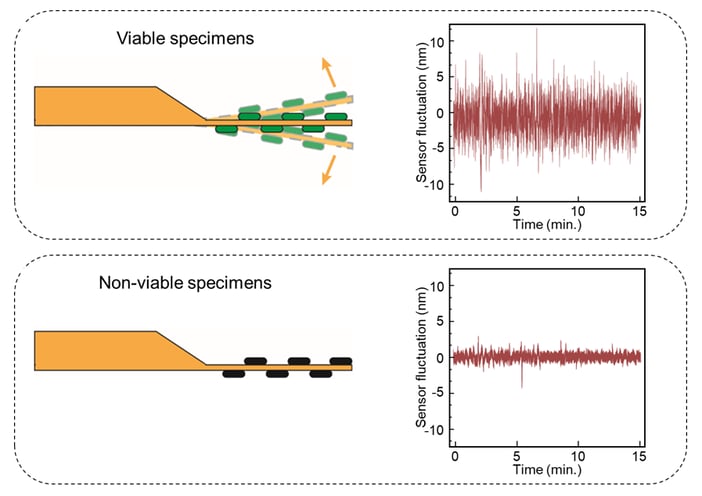
A scheme illustrating the working principle of nanomotion sensor. Image credits: Giovanni Longo, Consiglio Nazionale delle Ricerche, Italy
For example, Longo’s group uses the same technique to explore how neurons communicate: not only through electrical or chemical signalling, but also through mechanical stimulation. “By vibrating, each neuron influences nearby neurons, which can sense these same vibrations, and respond to them.” says Longo.
These nanomotion sensor experiments are conducted using a FlexAFM. “We used to build our instruments ourselves, so now we know how to work inside the system. Whenever we need to change something, we do it without any problem,” says Longo. Thanks to its versatility, the FlexAFM can be adapted to various experimental conditions. In Longo’s laboratory, it is mounted on an optical microscope equipped with an incubator set at 37 °C and 5% CO₂.
“The FlexAFM offers enormous advantages both in terms of stability and because it is compact, which allows us to use it in different situations. It works extremely well for biological studies and is clearly designed by a team that understands what a biologist needs when working with it. We routinely use the FlexAFM for experiments on living cells, and we use it with great satisfaction because it enables us to perform any type of experiment”, says Longo.
To perform nanomotion sensing, the AFM cantilever is functionalized with fibronectin, glutaraldehyde, or poly-lysine, molecules that bind to the cantilever and allow cells to attach firmly. When the cantilever is exposed to a drop of solution containing bacteria, they settle on the surface and remain attached. Eukaryotic cells, by contrast, are grown in a Petri dish and then brought into contact with the cantilever. “At that point, the cell prefers to attach to the cantilever rather than the substrate, and then we lift it up. We call this process fishing, and in this way, we capture one, two, or three cells, we know where we place them, and then we perform our experiments,” says Longo. Once the bacteria or cells are on the cantilever, it can be retracted from the surface and used to monitor their vibrations, giving information on the activity of the system.
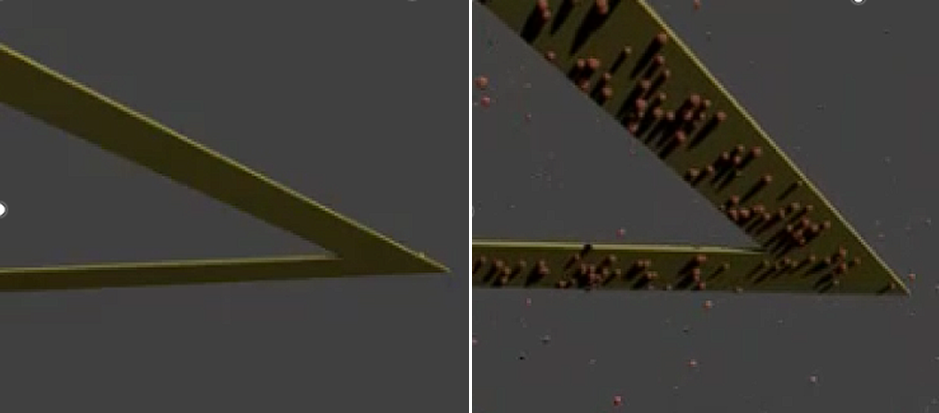
Cantilever before (left) and after (right) immobilizing biological systems. Image credits: Giovanni Longo, Consiglio Nazionale delle Ricerche, Italy
Although the group primarily conducts fundamental research, the technique has practical applications. “We can use this nanomotion sensor to place bacteria on a sensor, apply an antibiotic, and observe how the antibiotic kills the bacteria. This allows a fast analysis of the bacterial response.” After antibiotic treatment, it is possible to directly determine whether the bacteria are still alive and oscillating or dead, without waiting for their next replication cycles as is standard practice.
In their latest publication, Longo’s group studied Staphylococcus aureus, a common bacterium that can cause infections ranging from mild skin conditions to severe diseases and is notorious for its ability to develop antibiotic resistance. Staphylococcus aureus relies on iron for growth and often targets hemoglobin, which contains high levels of this element. To investigate the effects of iron deprivation, Longo removed iron from the nutrient supply and compared the oscillations of the wild-type strain with those of a mutant strain lacking the ability to assimilate iron. While monitoring bacterial replication rates, the researchers also measured oscillatory behavior.
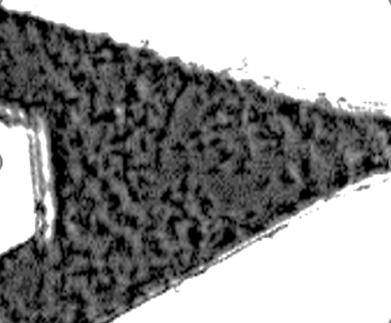
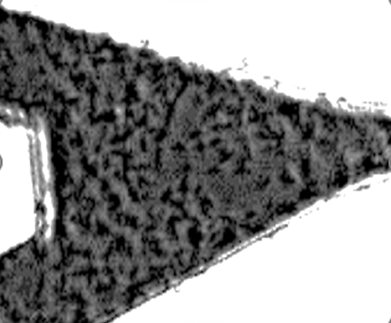
Cantilever covered by bacteria. Image credits: Giovanni Longo, Consiglio Nazionale delle Ricerche, Italy
“We synchronized all the bacteria, meaning we removed all the iron in a coordinated way, bringing them to the same state, , and when we restored the iron identically for all of them, we observed collective movements. They all moved in exactly the same way,” explains Longo. He continues, “This is the first time we have been able to link movements to a metabolic cycle, and we see that the response of this oscillating sensor shows a frequency pattern with peaks that are characteristic of Staphylococcus. This study holds great promise to determine rapidly new ways to fight these bacteria.”
23.06.2026
FlexAFM and nanomotion sensing unveil cellular responses, offering new insights into bacterial behavior and potential ...

27.05.2026
Explore Alejandro Silhanek’s innovative spintronics research, showcasing how spin waves can be investigated leveraging ...
.jpg?width=330&height=330&length=330&upsize=true&upscale=true&name=Mayfield%20Girls-202581%20(1).jpg)
19.05.2026
A group of young girls from Mayfield school wanted to start a F24 electric car racing team, and Nanosurf decided to ...
11.07.2024
FridayAFM: learn how to perform datamining on large sets of AFM data.
02.07.2024
FridayAFM: learn how to automatize data analysis in MountainsSPIP
26.06.2024
FridayAFM: learn how AFM makes possible modern ball point pens.
Interested in learning more? If you have any questions, please reach out to us, and speak to an AFM expert.